Going from slow cooker to Instant Pot takes more than swapping hours for minutes. The formulas online disagree wildly: one says 8 hours on Low equals about 2 hours under pressure, another says 30 to 60 minutes. That’s because the clock was never the point. The pressure time depends on the slowest-cooking ingredient in the pot, and whether the dish works depends on the liquid. Here’s the 7-step method, a time chart by cut, and a full beef stew conversion so you can see it in action.
- Why Slow Cooker Hours Don't Convert to Minutes
- How to Convert a Slow Cooker Recipe to Instant Pot in 7 Steps
- Slow Cooker to Instant Pot Time Chart
- How Much Liquid to Use
- Ingredients That Wait Until After Pressure Cooking
- Worked Example: Slow Cooker Beef Stew, Converted
- Troubleshooting Converted Recipes
- Or Use the Slow Cook Button
- Our Top Picks for Converting Slow Cooker Recipes
- Frequently Asked Questions
- Put It Into Practice
Quick Answer
- Time: set it by the main ingredient and the size you cut it, not by the slow cooker hours. Example: 1½-inch beef stew cubes take 20–25 minutes at High Pressure.
- Liquid: reach your model’s minimum of thin liquid (1½ cups in a 6-quart Instant Pot Duo, per its current manual), then trim the extra, because almost nothing evaporates.
- Add later: dairy, flour or cornstarch, pasta and tender vegetables go in after pressure cooking.
Why Slow Cooker Hours Don’t Convert to Minutes
A slow cooker spends its first hours just warming the food up, then holds it at a gentle simmer. Recipes give it a wide margin: chicken breasts and a chuck roast can both say “8 hours on Low,” and both come out edible. A pressure cooker works at about 240°F (115°C) and gives you no margin at all. Chicken breasts need about 8 minutes; a whole chuck roast needs about an hour.
So the reliable method works the other way round. Look up the pressure time for the main ingredient at the size you cut it, then build the rest of the recipe around that number.
How to Convert a Slow Cooker Recipe to Instant Pot in 7 Steps
- Find the anchor ingredient. It’s whatever takes longest, usually the meat or dried beans. Its cut and size set the cook time: use the chart below.
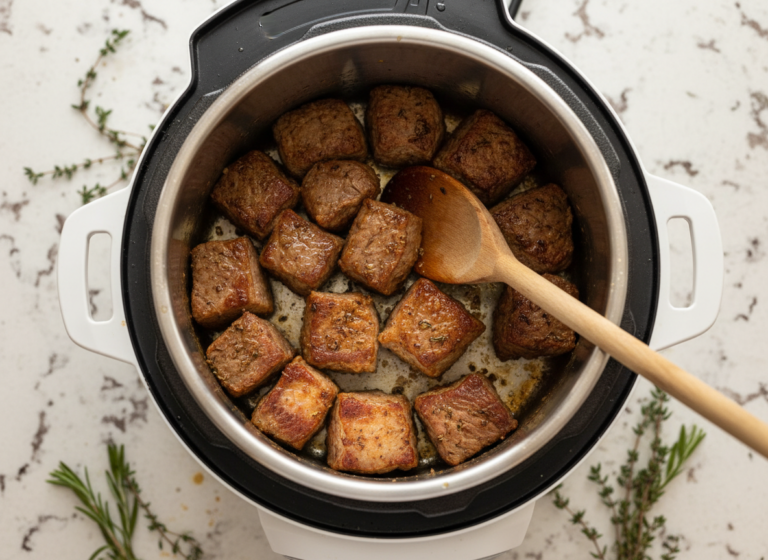
- Brown on Sauté. Many slow cooker recipes skip this step. Five to eight minutes of browning, in batches so the pot isn’t crowded, builds the depth a long simmer would have given you.
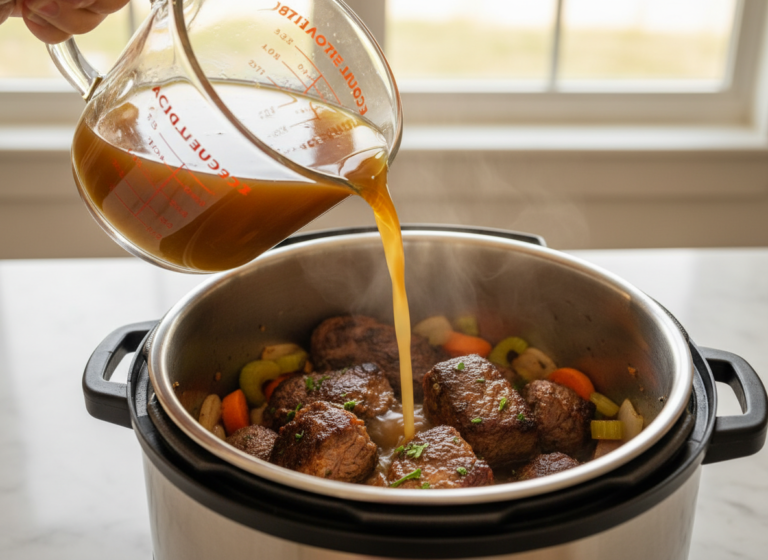
- Deglaze. Pour in some of the broth and scrape the bottom until it feels smooth. Browned bits left stuck there are the top cause of the Instant Pot burn message.
- Fix the liquid. Count only thin liquids: broth, water, wine, juice. Make sure you reach your model’s minimum. For a stew or braise, cut anything much beyond that, because the meat and vegetables release their own juices and nothing boils off. Soups keep their liquid.
- Layer thick ingredients on top. Crushed tomatoes, tomato paste, BBQ sauce and condensed soup go over the food in an even layer. Don’t stir them in.
- Set the time and the release. Cook at High Pressure for the anchor ingredient’s time. Let meat and beans release naturally for 10–15 minutes; quick release for vegetables and chicken breast. Allow another 10–20 minutes for the pot to come up to pressure.
- Finish on Sauté. Stir in the dairy, thickener, tender vegetables and fresh herbs, and simmer for a few minutes until the sauce turns glossy. Taste last: a pinch of salt or a squeeze of lemon often wakes a pressure-cooked dish up.
Check the fill line too. A slow cooker can be filled almost to the rim; an Instant Pot can’t. Stay under the PC MAX line (two-thirds full), or the half line for beans and grains, which foam and expand. If the recipe doesn’t fit, scale it down.
Slow Cooker to Instant Pot Time Chart
Times are at High Pressure in a 6-quart electric pressure cooker at sea level, with thawed meat. They sit in the middle of the ranges given by widely used charts such as Paint the Kitchen Red. If the meat isn’t fork-tender, seal the pot again and add 5 minutes. Above 2,000 feet, a common rule of thumb is to add about 5% per extra 1,000 feet.
| Main ingredient | Slow cooker | Instant Pot (High) | Release |
|---|---|---|---|
| Beef chuck roast, whole (3 lb) | 8–10 h Low | 60 min | Natural, 15 min |
| Beef stew meat, 1½-inch cubes | 7–8 h Low | 20–25 min | Natural, 10 min |
| Pork shoulder, boneless (3–4 lb, cut in 4) | 8–10 h Low | 60 min | Natural, 15 min |
| Baby back ribs (1 rack, cut to fit) | 6–8 h Low | 25 min | Natural, 10 min |
| Whole chicken (4 lb) | 6–8 h Low | 24 min (6 min per lb) | Natural, 15 min |
| Bone-in chicken thighs | 4–6 h Low | 10 min | Natural, 10 min |
| Boneless chicken breasts or thighs | 3–4 h Low | 8–10 min | Natural, 5–10 min |
| Ground beef chili, canned beans | 6–8 h Low | 10–15 min | Natural, 10 min |
| Dried black beans, unsoaked | 8 h Low | 25–30 min | Full natural |
| Dried pinto beans, unsoaked | 8 h Low | 35–40 min | Full natural |
How Much Liquid to Use
A pressure cooker needs enough thin liquid to boil and make steam. Below the minimum, it won’t come up to pressure or it shows a burn warning. Above it, extra liquid just stays in the pot, so the sauce comes out thinner than the slow cooker version. The current Instant Pot Duo manual lists these minimums:
| Pot size | Minimum thin liquid |
|---|---|
| 3 quart | 1 cup (250 mL) |
| 6 quart | 1½ cups (375 mL) |
| 8 quart | 2 cups (500 mL) |
Other models and brands vary, and some allow 1 cup in a 6-quart pot, so check your own manual. Still choosing a pot? Our Instant Pot size guide compares the 3-, 6- and 8-quart models. Thick liquids like canned crushed tomatoes, sauces and condensed soups don’t count toward the minimum.
In a slow cooker, the clock is forgiving. In a pressure cooker, the cut of meat sets the time and the thin liquid makes the pressure.
Ingredients That Wait Until After Pressure Cooking
- Milk, cream, sour cream and cheese: they can curdle or scorch under pressure. Stir them in on Sauté once the lid is off.
- Flour and cornstarch: they turn the liquid into a paste that can’t boil. Mix about 1 tablespoon of cornstarch per cup of liquid with the same amount of cold water, stir it in on Sauté and simmer for 1–2 minutes.
- Pasta and rice: slow cooker recipes often add them near the end. Cook them separately and fold them in.
- Tender vegetables and fresh herbs: peas, spinach, zucchini and parsley cook in the residual heat in 2–3 minutes.
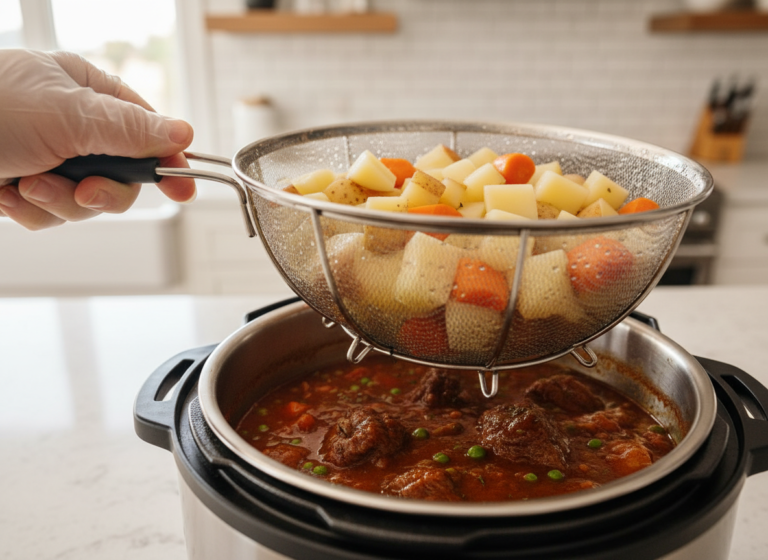
- Potatoes and carrots with long-cooking meat: use a two-stage cook. Pressure cook the meat, quick release, add the vegetables (a mesh steamer basket makes them easy to lift out), then cook 3–4 minutes more.
Worked Example: Slow Cooker Beef Stew, Converted
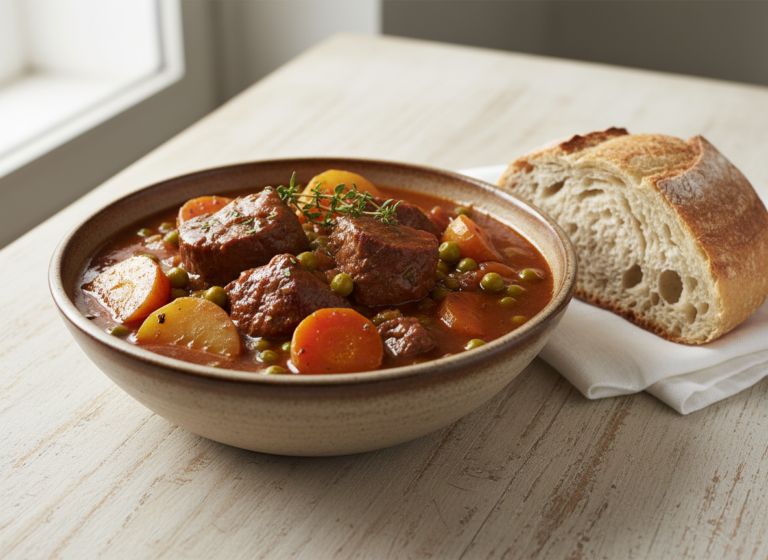
Here’s a typical slow cooker beef stew for 6 servings, and the same stew rebuilt for a 6-quart Instant Pot.
| Step | Slow cooker | Instant Pot |
|---|---|---|
| Beef | 2 lb chuck in 1½-inch cubes, raw into the pot | Same 2 lb, browned on Sauté in 2 batches, about 4 minutes each |
| Liquid | 4 cups beef broth | 2 cups beef broth to deglaze; 2 tbsp tomato paste spooned on top, not stirred |
| Vegetables | 1 onion, 1 lb potatoes, 3 carrots, all at the start | Onion with the beef; potatoes (1½-inch) and carrots (1-inch) after the first cook |
| Thickener | ¼ cup flour tossed with the raw beef | 2 tbsp cornstarch + 2 tbsp cold water, stirred in at the end |
| Cook | 8 hours on Low | 20 min High + 10 min natural release, then 4 min High + quick release |
| Finish | None | 1 cup frozen peas stirred in on Sauté for 2 minutes |
| Total time | About 8 h 15 min | About 1 h 15 min |
Two cups of broth looks low next to the original, but the beef and vegetables release their juices and the pot loses almost nothing to steam. Once thickened, the stew ends up as thick as the slow cooker version. Add another tablespoon of cornstarch slurry if you like it thicker. Because flour coating the beef sits right on the hot bottom, it moves to the end as a slurry.
Troubleshooting Converted Recipes
| Problem | Likely cause | Fix |
|---|---|---|
| Burn message | Thick sauce or browned bits on the bottom | Deglaze; layer thick sauces on top |
| Thin, watery sauce | All the slow cooker liquid was kept | Simmer on Sauté 5–10 min or add a slurry; cut the liquid next time |
| Tough meat | Not enough time, or a quick release | Pressure cook 5–10 min more, then release naturally |
| Mushy vegetables | Cooked as long as the meat | Use a two-stage cook |
| Never comes to pressure | Too little thin liquid, or the ring or valve | Add liquid; check the sealing ring and set the valve to Sealing |
| Flat flavor | Browning and deglazing skipped | Brown in batches; finish with salt and a little acid |
Or Use the Slow Cook Button
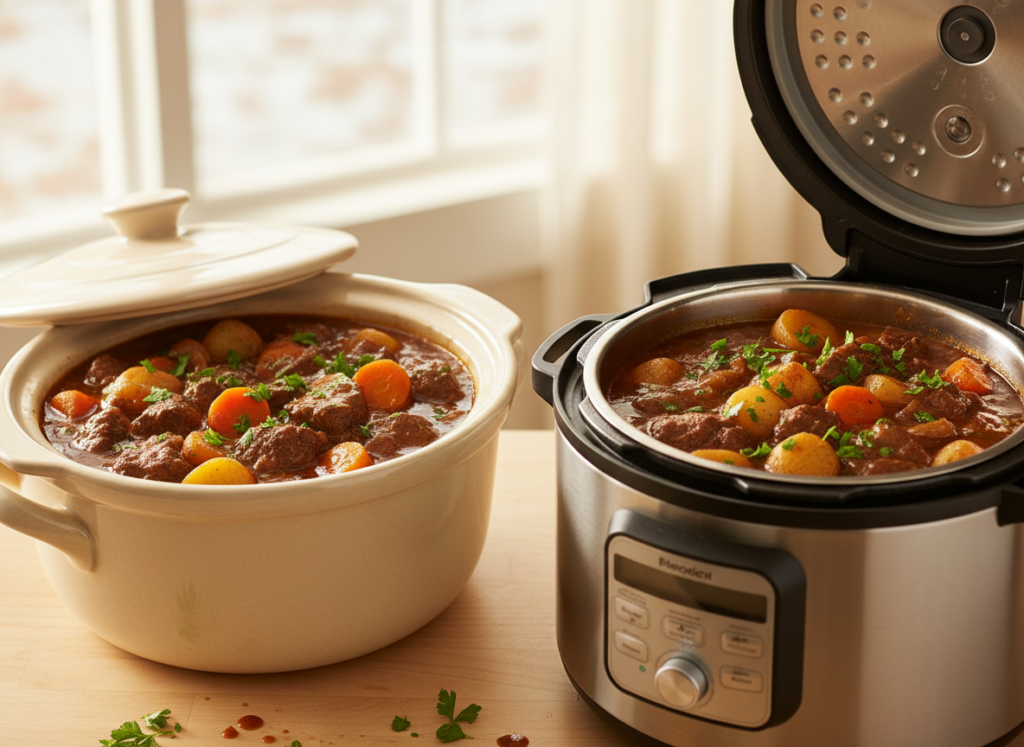
If you’d rather keep a recipe exactly as written, most Instant Pot models have a Slow Cook program. On Duo models the settings are Less, Normal and More, with default times of 8, 6 and 4 hours. The stainless steel pot heats more gradually than a ceramic crock, so check doneness and allow extra time if needed.
Swap the pressure lid for a vented tempered glass lid. You can check the food without lifting it, and every time you open the pot it loses heat.
Our Top Picks for Converting Slow Cooker Recipes
We make our pressure-cooker recipes in an electric pressure cooker. These three accessories make the switch from slow cooker easier.
- Instant Pot Tempered Glass Lid, 6 Qt (about $15–25): the brand’s own lid for 5- and 6-quart inner pots, for Slow Cook and Keep Warm. Engadget found it makes the Slow Cook program far more practical.
- OXO Good Grips 4-Cup Fat Separator (about $15–20): the fat that cooks off a pork shoulder or chuck roast stays in the pot. Pour the juices through this before you thicken them. It was Wirecutter’s top pick after testing 10 models.
- Instant Pot Official Large Mesh Steamer Basket (about $15–20): for the two-stage cook, it holds potatoes and carrots above or inside the stew and lifts them out in one go. It doubles as a strainer.


Research-based picks: based on manufacturer specifications, verified buyer feedback and published documentation. We haven’t tested these products ourselves (how we work). Last verified: October 3, 2026.
As an Amazon Associate, we earn from qualifying purchases. Prices are approximate and may change — please verify on Amazon before buying.
Frequently Asked Questions
Can I use frozen meat when converting a slow cooker recipe?
Yes, and it’s one advantage of the switch: the USDA advises thawing meat before it goes into a slow cooker, but a pressure cooker can start from frozen. Plan on about 50% more pressure time, and you won’t be able to brown it first.
If I double the recipe, do I double the time?
No. In pressure cooking, the time depends on the size of each piece, not the total amount. A double batch takes longer to come up to pressure, but the cook time stays the same as long as you stay under the PC MAX line.
How do I convert an Instant Pot recipe back to the slow cooker?
Plan on 6–8 hours on Low for tough cuts and 3–4 hours for chicken. Swap lean cuts for fattier ones (thighs instead of breasts, chuck instead of sirloin), cut vegetables to the same size so they finish together, and still add dairy at the end.
Put It Into Practice
Our Lazy Day Beef Stew and Dump-and-Go Slow Cooker Chili are good first tries for this slow cooker to Instant Pot method: find the beef in the chart, cut the broth to your minimum and layer the tomatoes on top. For a recipe written for the pressure cooker from the start, try our Instant Pot Butter Chicken, or browse all our pressure and slow cooking recipes.
Get Our Free Dessert Recipe eBook
Join the Kitchen Unveiled newsletter and get our free dessert recipe eBook when you sign up. Subscribe now and get your free eBook →
You might also like: Instant Pot Burn Message: Why It Happens and How to Fix It and How to Meal Prep Like a Pro.