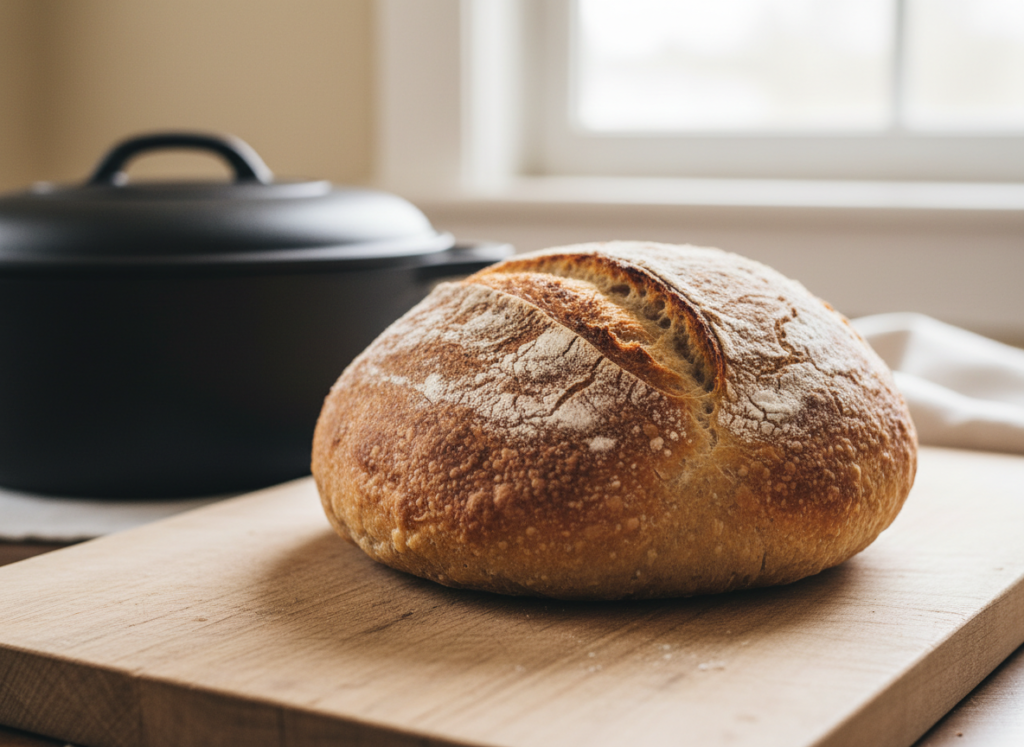
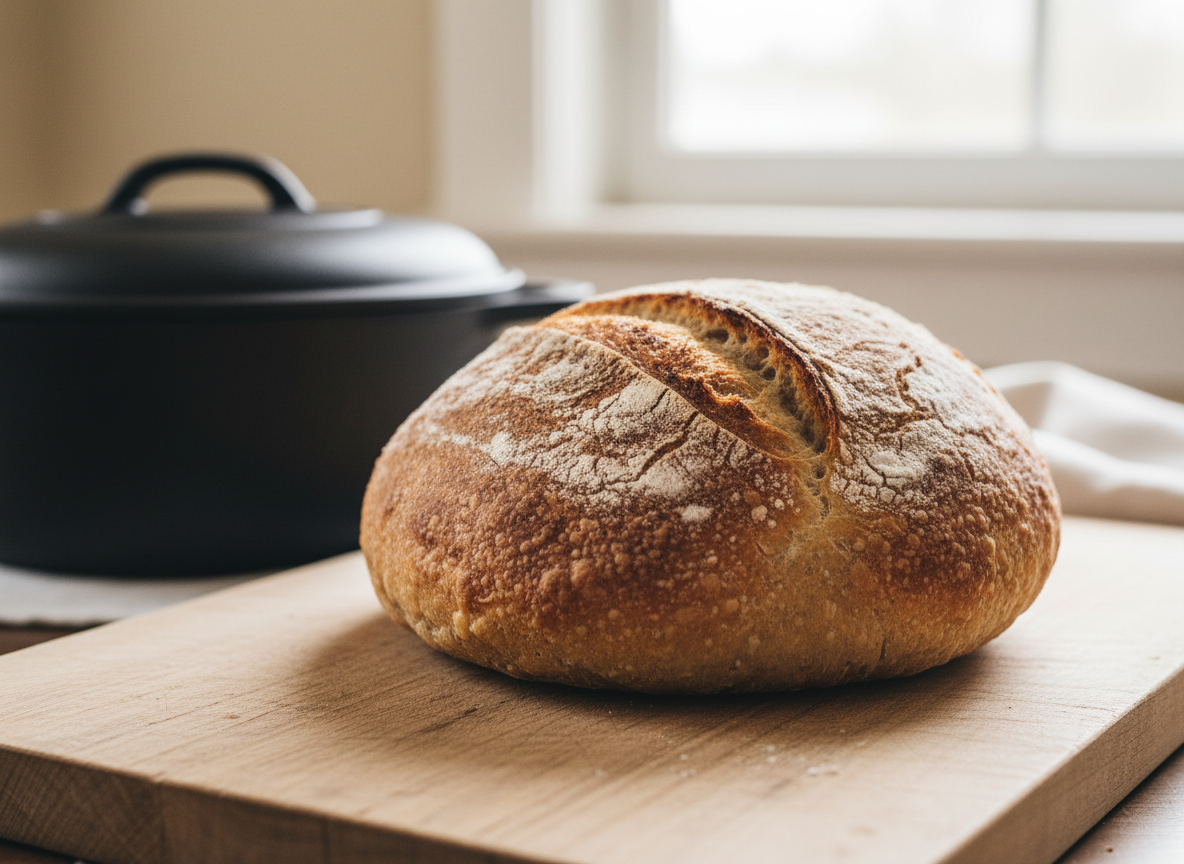
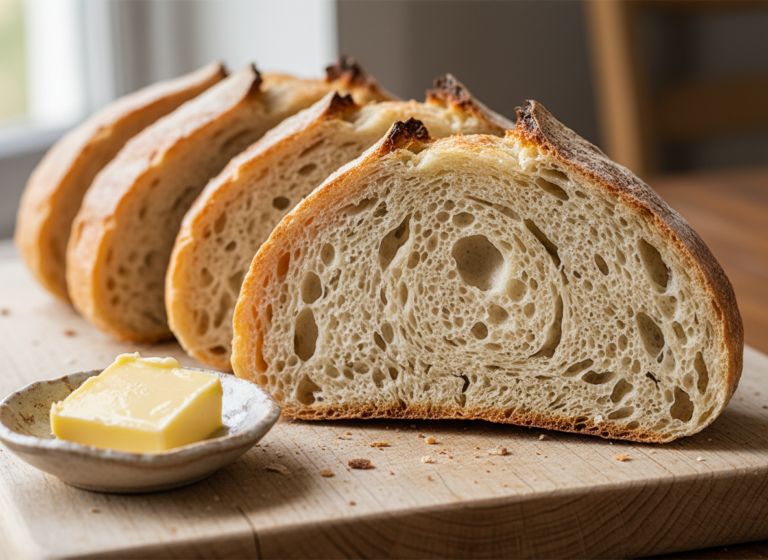
This no-knead Dutch oven bread asks for four pantry ingredients and about five minutes of actual work. You stir a shaggy dough in the evening, let time build the gluten overnight, and bake it the next afternoon in a preheated pot that traps steam like a bakery oven. The result is a loaf with a crackly, deep-brown crust and a chewy, open crumb. The schedule below fits around a workday.
At a Glance
- Hands-on time: about 10 minutes. Rise: 12–18 hours plus 1–2 hours. Bake: 45–50 minutes.
- Makes: 1 round loaf, about 8 slices. Difficulty: easy.
- The one thing that makes it work: a lidded pot preheated for a full 30 minutes at 450°F.
Recipe
No-Knead Dutch Oven Bread
Ingredients
Method
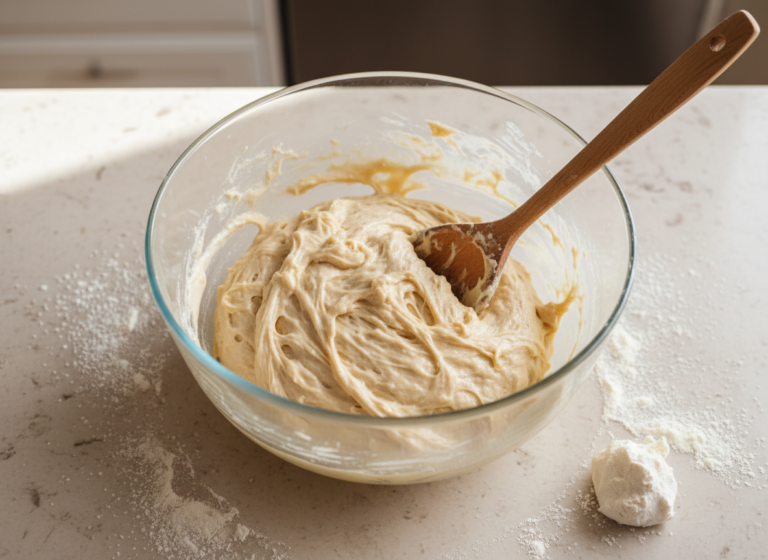
- Mix (evening): in a large bowl, whisk the flour, salt and yeast. Add the water and stir with a spoon or spatula for about 30 seconds, until no dry flour remains. The dough will look shaggy and sticky. Cover the bowl with a plate or plastic wrap.
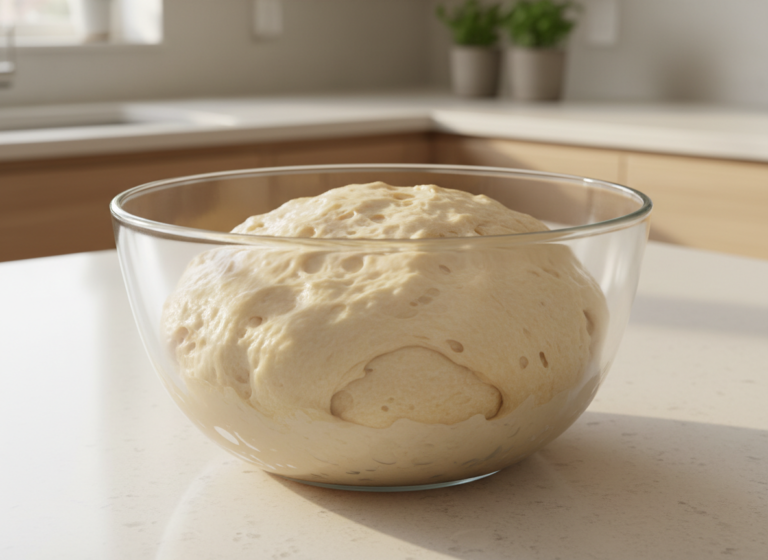
- First rise: leave the bowl at room temperature (about 70–72°F) for 12–18 hours, until the dough has more than doubled, the surface is dotted with bubbles and it jiggles when you shake the bowl. In a cooler kitchen, give it the full 18 hours.
- Shape: dust the counter lightly with flour and scrape the dough out. With floured hands, fold the edges into the center 4–6 times to make a round. Set it seam-side down on a 12 x 16-inch sheet of parchment paper and dust the top with flour or cornmeal.
- Second rise: cover loosely with a towel and let it rise for 1–2 hours, until nearly doubled. Poke it about ¼ inch deep: it’s ready when the dent springs back slowly and doesn’t disappear.
- Preheat the pot: about 30 minutes before the dough is ready, put the covered Dutch oven on a rack in the lower third of the oven and heat it to 450°F (230°C). Let the pot heat for the full 30 minutes.
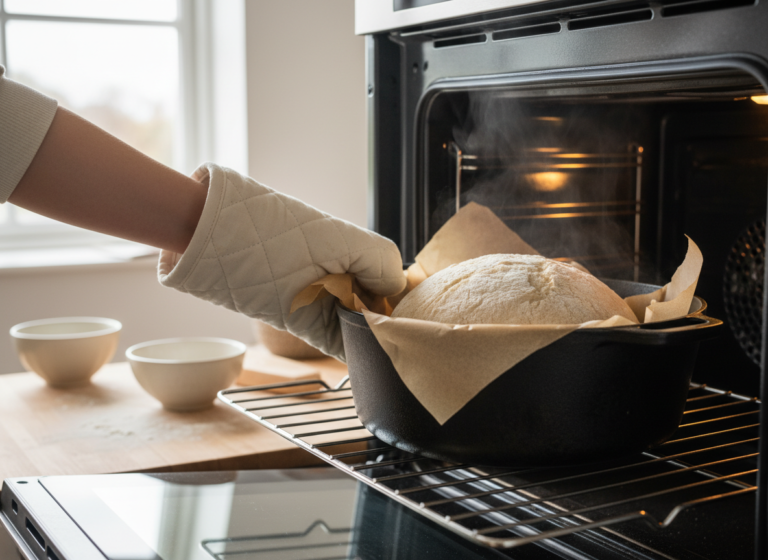
- Bake covered: take out the hot pot and remove the lid. Lift the dough by the parchment and lower it, paper and all, into the pot. If you like, slash the top ½ inch deep with a sharp knife. Cover and bake for 30 minutes.
- Bake uncovered: remove the lid and bake 15–20 minutes more, until the crust is a deep chestnut brown. The loaf is done at 205–210°F inside, or when it sounds hollow when tapped underneath.
- Cool: lift the loaf out by the parchment onto a wire rack and let it cool for at least 1 hour before slicing. The crumb is still setting as it cools.
Notes
✓ Kitchen-tested · Nicole cooked this recipe in our kitchen on November 2, 2026. What this means
Why This No-Knead Dutch Oven Bread Works
- Time does the kneading. Over 12–18 hours, the wet flour forms gluten on its own, the same structure kneading builds by hand. A long, slow rise also gives the bread more flavor.
- A tiny amount of yeast. Just ¼ teaspoon keeps the rise slow and steady, so the dough doesn’t overproof overnight.
- A wet dough. At 75% water to flour by weight, the dough makes plenty of steam inside, which gives the open, airy crumb.
- A hot, covered pot. The lid traps the steam from the dough, so the crust stays soft long enough for the loaf to rise fully. Taking the lid off for the last 15–20 minutes lets it brown and crackle.
A Schedule That Fits a Workday
The long rise sounds like a commitment, but almost all of it happens while you sleep or work. Here’s one timeline for fresh bread on a weekend afternoon.
| When | What you do | Your time |
|---|---|---|
| Friday, 8 pm | Mix the dough and cover it | 5 min |
| Saturday, 12–2 pm | Shape and start the second rise | 5 min |
| 1–2 hours later | Preheat the pot for 30 minutes | 1 min |
| Then | Bake 30 min covered, 15–20 min uncovered | 2 min |
| 1 hour after baking | Slice and serve | — |
Need more flexibility? After 12 hours at room temperature, cover the bowl and refrigerate the dough for up to 3 days. The flavor gets slightly tangier. Shape it straight from the fridge and give the second rise the full 2 hours.
Tips for a Better Loaf
- Use a parchment sling. It turns the scariest step, dropping soft dough into a 450°F pot, into a calm lift-and-lower.
- Check your lid knob. Some enameled Dutch ovens have plastic knobs rated below 450°F. Check your manual, or swap it for a stainless knob. Bare cast iron has no such limit.
- Keep extra flour to a minimum. A sticky dough is normal. Use floured hands and a bench scraper rather than working more flour in.
- Trust the color. Pale bread is underbaked bread. Go for deep chestnut brown, not golden.
Common Mistakes and How to Fix Them
| Problem | Likely cause | Fix |
|---|---|---|
| Dense, flat loaf | First rise too short or kitchen too cold | Wait until the dough has more than doubled and is bubbly, even past 18 hours |
| Gummy center | Underbaked, or sliced while hot | Bake to 205–210°F inside and cool a full hour |
| Pale, soft crust | Pot not preheated long enough | Preheat the covered pot for the full 30 minutes; bake uncovered until deep brown |
| Burnt bottom | Rack too low or oven runs hot | Move the rack up one level and check your oven with a thermometer |
| Dough spreads like a puddle | Overproofed second rise | Shorten the second rise; bake as soon as the poke test springs back slowly |
The work in no-knead bread isn’t in your hands. It’s in the clock and the hot pot.
Substitutions and Variations
| Swap | What changes |
|---|---|
| All-purpose flour instead of bread flour | Works; the crumb is a little softer and less chewy |
| 1 cup (130 g) whole wheat flour replacing the same amount of bread flour | Nuttier and a bit denser; add 1–2 tablespoons more water |
| Active dry yeast instead of instant | Same amount, stirred in with the flour |
| ¾ cup shredded sharp cheddar + 1 diced jalapeño | Fold in during shaping |
| 2 tablespoons chopped fresh rosemary + 4 cloves roasted garlic | Fold in during shaping |
Storage: keep the loaf cut-side down on a board for up to 1 day, or in a paper bag for 2. For longer, slice it and freeze for up to 3 months. A few minutes in a 350°F oven brings the crust back.
Equipment for No-Knead Bread
Any heavy, oven-safe pot with a tight lid works, from 4½ to 6 quarts. A bare cast iron Dutch oven is the easiest choice, since it handles a long empty preheat without worry. Keep it in shape with our guide on how to clean cast iron.
- Lodge 5-Quart Pre-Seasoned Cast Iron Dutch Oven (about $40–60): a long-standing reference in its category, with loop handles that are easy to grip in oven mitts.
- OXO Good Grips Multi-Purpose Scraper and Chopper (about $10–15): a stainless bench scraper that lifts sticky dough off the counter and folds it without extra flour.
- TempPro TempSwift Instant-Read Thermometer (about $10–15): the surest way to know the loaf has reached 205–210°F inside.


Research-based picks: based on manufacturer specifications, verified buyer feedback and published documentation. We haven’t tested these products ourselves (how we work). Last verified: October 4, 2026.
As an Amazon Associate, we earn from qualifying purchases. Prices are approximate and may change — please verify on Amazon before buying.
Frequently Asked Questions
Can I use a smaller or larger Dutch oven?
Yes, anything from about 4 to 7 quarts works. In a wider pot the loaf spreads more and bakes up flatter; in a smaller one it rises taller. The bake times stay the same.
Why is my no-knead bread gummy inside?
It was either underbaked or sliced too soon. Bake until the center reaches 205–210°F and let the loaf cool for a full hour: steam is still finishing the crumb as it cools.
Who invented no-knead bread?
The method was popularized by New York baker Jim Lahey and shared widely in 2006. The history of no-knead bread covers how a long, slow rise replaces kneading.
More to Cook in Your Cast Iron
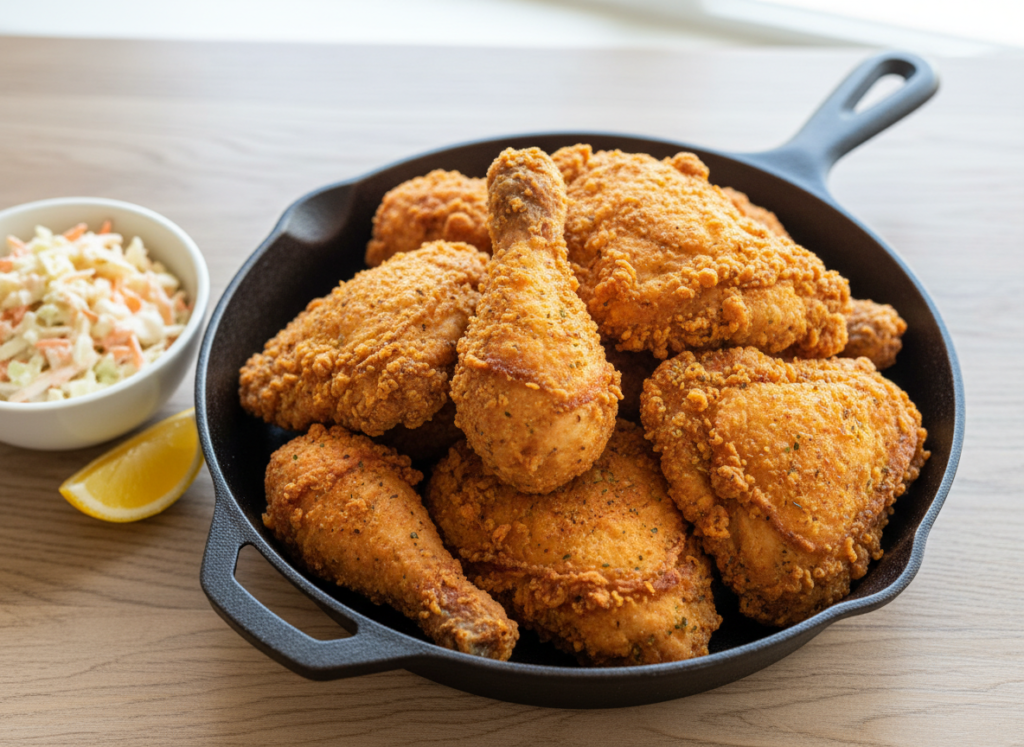
Once your pot is out, put it to work again: our Crispy Southern Fried Chicken uses the same heavy iron for steady frying heat. Find more ideas in our cast iron and Dutch oven recipes.
Get Our Free Dessert Recipe eBook
Join the Kitchen Unveiled newsletter and get our free dessert recipe eBook when you sign up. Subscribe now and get your free eBook →
You might also like: Crispy Korean Fried Chicken with Gochujang Sauce and Fudgy Homemade Brownies with a Perfect Crackly Top.